


Description
- DigiTek® (DPTR-7060VD) Platinum Heavy Duty tripod
- 2-Way Head with Adjustable PAN
- Steady Non-Slip Foot Pad
- Bubble Head to Adjust Horizontal Position
- Multipurpose Head with Quick Release & for DV Cameras
-

DESCRIPTION
DIGITEK DPTR-7060VD Platinum Heavy Duty Video Tripod, For DSLR Cameras and Video Camcorders, Maximum Operating Height 1849 mm, Maximum Load Upto 20 kgs

HIGHLIGHTS
- Leg Lock : Twist Lock
- Maximum Height: 184.9 cm
- Leg sections: 3
- Center Column Type: Rapid
- Camera Mounting Screw: 1/4 inch-20 inch, Male
SPECIFICATIONS
GENERALIn The BoxTripod, Carry BagBrandDigitekColorBlackModel NameDPTR-7060VDHEADQuick Release Plate TypeArca-TypeCamera Mounting Screw1/4 inch – 20 inch, MaleA tripod is a portable three-legged frame or stand, used as a platform for supporting the weight and maintaining the stability of some other object. The three-legged (triangular stance) design provides good stability against gravitational loads as well as horizontal shear forces, and better leverage for resisting tipping over due to lateral forces can be achieved by spreading the legs away from the vertical centre. Variations with one, two, and four legs are termed monopod, bipod, and quadripod (similar to a table).
Etymology
First attested in English in the early 17th century, the word tripod comes via Latin tripodis (GEN of tripus),[1][2] which is the romanization of Greek τρίπους (tripous), “three-footed” (GEN τρίποδος, tripodos),[3] ultimately from τρι- (tri-), “three times”[4] (from τρία, tria, “three”)[5] + πούς (pous), “foot”.[6] The earliest attested form of the word is the Mycenaean Greek 𐀴𐀪𐀠, ti-ri-po, written in Linear B syllabic script.[7]
Cultural use
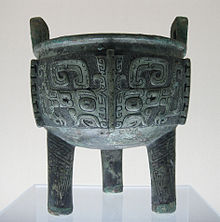
A ding (Chinese ceremonial cauldron) from late Shang Dynasty. Many cultures, including the ancient peoples of China and Greece, used tripods as ornaments, trophies, sacrificial altars, cooking vessels or cauldrons, and decorative ceramic pottery. Tripod pottery have been part of the archaeological assemblage in China since the earliest Neolithic cultures of Cishan and Peiligang in the 7th and 8th millennium BC.[8] Sacrificial tripods were found in use in ancient China usually cast in bronze but sometimes appearing in ceramic form.[9] They are often referred to as “dings” and usually have three legs, but in some usages have four legs.
The Chinese use sacrificial tripods symbolically in modern times, such as in 2005, when a “National Unity Tripod” made of bronze was presented by the central Chinese government to the government of northwest China’s Xinjiang Uygur Autonomous Region to mark its fiftieth birthday. It was described as a traditional Chinese sacrificial vessel symbolizing unity.[10]
In ancient Greece, tripods were frequently used to support lebes, or cauldrons, sometimes for cooking and other uses such as supporting vases.
Firearms

Seabees train with the M240B mounted on the M122 tripod. Tripods are commonly used on machine guns to provide a stable mount for the weapon when firing.[11]
Tripods are generally restricted to heavier weapons where the weight would be an encumbrance. For lighter weapons such as rifles, a bipod is more common. However, in recent times tripod saddles have become popular for precision rifle shooting sports, with the weapon placed in a vise-like rest which is mounted to a tripod head[12][13] or with the weapon mounted directly to the tripod head.
Photography DigiTek

A photographic tripod In photography, a tripod is a portable device used to support, stabilize and elevate a camera, a flash unit, or other videographic or observational/measuring equipment. All photographic tripods have three legs and a mounting head to couple with a camera. The mounting head usually includes a thumbscrew that mates to a female-threaded receptacle on the camera, as well as a mechanism to be able to rotate and tilt the camera when it is mounted on the tripod. Tripod legs are usually made to telescope, in order to save space when not in use. Tripods are usually made from aluminum, carbon fiber, steel, wood or plastic.
Surveying
A surveyor’s tripod is a device used to support any one of a number of surveying instruments, such as theodolites, total stations, levels or transits.Astronomy
The astronomical tripod is a sturdy three-leg stand used to support telescopes or binoculars, though they may also be used to support attached cameras or ancillary equipment. The astronomical tripod is normally fitted with an altazimuth or equatorial mount to assist in tracking celestial bodies.[14][15]
Laboratory

Laboratory tripod A laboratory tripod is a three-legged platform used to support flasks and beakers. Tripods are usually made of stainless steel or aluminium and made light-weight for efficient portability within the lab. Often a wire gauze is placed on top of the tripod to provide a flat base for glassware. Tripods are generally tall enough for a bunsen burner to be placed underneath.[16]See also
- ISO 1222 (tripod screw mount)
- Trivet
- Triskelion
- In photography, a tripod is a portable device used to support, stabilize and elevate a camera, a flash unit, or other videographic or observational/measuring equipment. All photographic tripods have three legs and a mounting head to couple with a camera. The mounting head usually includes a thumbscrew that mates to a female-threaded receptacle on the camera, as well as a mechanism to be able to rotate and tilt the camera when it is mounted on the tripod. Tripod legs are usually made to telescope, in order to save space when not in use. Tripods are usually made from aluminum, carbon fiber, steel, wood or plastic.
Usage

Photographers with heavy telephoto lens attachments use a tripod to stabilize their camera to get sharp images Tripods are used for both still and motion photography to prevent camera movement. They are necessary when slow-speed exposures are being made, or when lenses of extreme focal length are used, as any camera movement while the shutter is open will produce a blurred image. In the same vein, they reduce camera shake, and thus are instrumental in achieving maximum sharpness. A tripod is also helpful in achieving precise framing of the image, or when more than one image is being made of the same scene, for example when bracketing the exposure. The use of a tripod may also allow for a more thoughtful approach to photography. For all of these reasons, a tripod of some sort is often necessary for professional photography. Tripods are also used as an alternative to C-Stands as photographic accessories.
Construction

Berlebach Tripod Report 422 made from wood (ash) For maximum strength and stability, most photographic tripods are braced around a center post, with collapsible telescoping legs and a telescoping section at the top that can be raised or lowered. At the top of the tripod is the head, which includes the camera mount (usually a detachable plate with a thumbscrew to hold on to the camera), several joints to allow the camera to pan, rotate and tilt, and usually a handle to allow the operator to do so without jostling the camera. Some tripods also feature integrated remote controls to control a camcorder or camera, though these are usually proprietary to the company that built the camera. Materials used in the construction of tripod or monopod legs include metal (typically bare or painted aluminum), wood and carbon fiber-reinforced plastics, among others.
Bolt threads
Per ISO 1222:2010,[1] the current tripod bolt thread standard for attaching the camera calls for a 1/4-20 UNC[2] or 3/8-16 UNC thread.[3] Most consumer cameras are fitted with 1/4-20 UNC threads. Larger, professional cameras and lenses may be fitted with 3/8-16 UNC threads, plus a removable 1/4-20 UNC adapter, allowing them to be mounted on a tripod using either standard.
Historically, The Royal Photographic Society recommended the thread standard for attaching older cameras to tripods was 3/16-24 BSW (3/16 inch nominal diameter, 24 threads per inch), or 1/4-20 BSW[4] for smaller cameras and 3/8-16 BSW[5] for larger cameras and pan/tilt heads. In this application, the BSW and UNC thread profiles are similar enough that one can mount a modern camera on a legacy tripod and vice versa. The UNC threads are at a 60-degree angle and flattened, whereas the BSW are at a 55-degree angle and rounded crest. However, at least one English manufacturer uses No.1 B.A. (British Association) for its tripod mount thread.
Variations

A tabletop tripod with a ball head. There are several types of tripods. The least expensive, generally made of aluminum tubing and costing less than US$50, is used primarily for consumer still and video cameras; these generally come with an attached head and rubber feet. The head is very basic, and often not entirely suitable for smooth panning of a camcorder. A common feature, mostly designed for still cameras, allows the head to flip sideways 90 degrees to allow the camera to take pictures in portrait format rather than landscape. Often included is a small pin on the front of the mounting screw that is used to stabilize camcorders. This is not found on the more expensive photographic tripods.
More expensive professional tripods are sturdier, stronger, and usually come with no integrated head. The separate heads allow a tripod-head combination to be customized to the photographer’s needs. There are expensive carbon fiber tripods, used for applications where the tripod needs to be lightweight. Many tripods, even some relatively inexpensive ones, also include leveling indicators for the legs of the tripod and the head.
Many of the more expensive tripods have additional features, such as a reversible center post so that the camera may be mounted between the legs, allowing for shots from low positions, and legs that can open to several different angles.

A tripod with flexible legs permitting it to grip to some objects. Small tabletop tripods (sometimes called tablepods) are also available, ranging from relatively flimsy models costing less than US$20, to professional models that can cost up to US$800 and can support up to 68 kg (150 lb). They are used in situations where a full sized tripod would be too bulky to carry. An alternative is a clamp-pod, which is a ball head attached to a C-clamp.
Another technique involves forming a string triangle held taut around the two feet of the photographer and linked to the camera. This negative string “tripod” can stabilize the camera sufficiently to use a shutter speed three stops slower.[6]
Heads
The head is the part of the tripod that attaches to the camera and allows it to be aimed. It may be integrated into the tripod, or a separate part. There are generally two different types of heads available.

A ball head, showing panoramic rotation lock lever, and ball lock knob. A ball head utilizes a ball joint to allow rotational movement about all axes from a single point. Some ball heads also have a separate panoramic rotation joint on the base of the head. The head has two main parts, the ball, which attaches to the camera, and the socket, which attaches to the tripod. The camera is attached to the ball by means of quick release plate or a simple UNC 1/4″-20 [7] screw. The socket encloses the rotating ball and also contains the controls for locking the ball. The socket has a slot on the side to allow the camera to be rotated to the portrait orientation. Ball heads come in varying degrees of complexity. Some have only one control for both ball and pan lock, while others have individual controls for the ball lock, pan lock, and ball friction. Ball heads are used when a free-flowing movement of the camera is needed. They are also more stable and can hold heavier loads than pan-tilt heads. However, ball heads have the disadvantage that only one control is available to allow or prevent movement of all axes of rotation, so if the camera is tilted around one axis, there may be a risk of rotation about the other axes as well.

A 3-way pan-tilt head on a tripod, showing panoramic rotation, lateral tilt, and front tilt controls When a movement around one or two axes or rotation is needed, a pan-tilt head is used. The pan-tilt head has separate joints and controls for tilting and panning, so that a certain axis can be controlled without affecting the other axes. These heads come in two types, called 2-way and 3-way. 2-way heads have 2 axes and controls, one for panoramic rotation and one for front tilt. 3-way heads have 3 axes and controls, one for panoramic rotation, front tilt, and lateral tilt. The controls on these heads are usually handles that can be turned to loosen or tighten the certain axis. This allows movement in one, several, or none of the axes. When the rotation around all axes is needed, a ball head is used. There are some pan-tilt heads that use gears for precision control of each axis. This is helpful for some types of photography, such as macro photography.
Other head types include the gimbal, fluid, gear, alt-azimuth, and equatorial heads. Fluid heads and gear heads move very smoothly, avoiding the jerkiness caused by the stick-slip effect found in other types of tripod heads. Gimbal heads are single-axis heads used in order to allow a balanced movement for camera and lenses. This proves useful in wildlife photography as well as in any other case where very long and heavy telephoto lenses are adopted: a gimbal head rotates a lens around its center of gravity, thus allowing for easy and smooth manipulation while tracking moving subjects.
Monopod
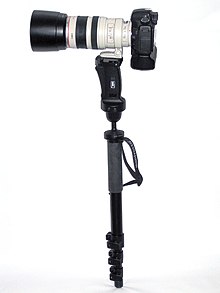
Camera and telephoto lens mounted on monopod In place of or to supplement a tripod, some photographers use a one-legged telescoping stand called a monopod for convenience in setup and breakdown. A monopod requires the photographer to hold the camera in place, but because the monopod reduces the number of degrees of freedom of the camera, and also because the photographer no longer has to support the full weight of the camera, it can provide some of the same stabilization advantages as a tripod.
Fixed tripods
For low-angle shots particularly in cinematography, short tripods with fixed length legs and no center column may be used. The lowest of these is called a low hat, with a slightly higher version referred to as a hi hat.[8]
Travel tripods
A travel tripod[9] is one that has been designed to fit certain criteria including lightness and rigidity to give the photographer the freedom to travel and carry their tripod for extended periods. It must be small and light enough to be carried as hand baggage yet has enough strength to support a professional DSLR and fast telephoto lens. Typical specifications for a travel tripod legs would be: Weight (without head): 2 to 4 lbs (0.9 to 1.8 kg), Height (contracted): 12 to 20 inches (30 to 50 cm), Height (extended): – 60 to 70 inches (152 to 178 cm) and Max Load: 5 to 10 lbs (2.3 to 4.6 kg).


Reviews
There are no reviews yet.